Charles Leclerc Sends a Message to Lando Norris After Their Dutch GP Sprint Battle
Charles Leclerc delivered a strong performance for Ferrari in the Formula One Sprint at the 2026 Dutch Grand Prix, securing second place after a late battle with McLaren driver Lando Norris.
The Ferrari star managed to overtake Norris during the closing stages of the 24-lap Sprint at Zandvoort, earning a valuable second-place finish. George Russell proved too far ahead for either driver to challenge, allowing the Mercedes driver to convert his pole position into victory in the first Sprint event ever held at the Dutch Grand Prix.
Russell controlled the race from the front and crossed the finish line 1.360 seconds ahead of Leclerc. Norris, meanwhile, had to settle for third after losing ground during the latter stages.
The result was especially impressive for Russell, who had started from pole and maintained control throughout the short race. Norris had been unable to create a serious opportunity to attack the Mercedes driver for the lead, despite remaining within striking distance for much of the event.
As the Sprint progressed, however, Norris began to lose performance. His tyres appeared to deteriorate, allowing Leclerc to close the gap and eventually move ahead.
Norris ultimately finished 5.196 seconds behind Russell, while Leclerc took the chequered flag in second. The Ferrari driver’s performance was notable because he had selected a different tyre strategy from the two drivers ahead of him.
Leclerc started the Sprint on Pirelli’s soft C4 compound, while both Russell and Norris opted for the medium C3 tyre. Choosing the softer tyre presented Ferrari with the possibility of gaining additional performance early in the race, but it also carried the risk of greater degradation over the 24 laps.
Despite that potential disadvantage, Leclerc managed his tyres effectively enough to remain competitive throughout the race. His pace became increasingly strong as Norris began to struggle.
The Ferrari driver later explained that making a different tyre choice from the drivers around him always involves an element of uncertainty. If the strategy works, it can provide a significant advantage, but if the tyres deteriorate too quickly, the decision can quickly become a mistake.
Leclerc nevertheless recognized that the circumstances were beginning to favor him as the Sprint entered its final stages.
Norris had initially managed to stay ahead, but his rear tyres began to lose performance. The McLaren driver also appeared to be using his battery energy at a faster rate than Leclerc expected.
This became particularly important because of Zandvoort’s long pit straight, where the ability to deploy electrical energy can make a major difference when defending a position.
Leclerc recognized that Norris was not saving enough battery power for the main straight. That meant the McLaren driver would have fewer resources available when he needed to defend against a late attack.
The Ferrari driver saw his opportunity on Lap 18 of the 24-lap Sprint. Approaching Turn 1, known as Tarzanbocht, Leclerc made his move and successfully got past Norris.
The overtake represented an important moment in the race. Until that point, Norris had remained in control of second place, but the combination of tyre degradation and battery management ultimately left him vulnerable.
Leclerc’s decision to attack at that particular moment demonstrated how closely he was monitoring Norris’s car. Rather than simply relying on his own pace, the Ferrari driver was assessing how his rival was using his available energy and looking for signs that the McLaren was becoming weaker.
Once Leclerc moved ahead, Norris was unable to respond. The Ferrari driver established a comfortable advantage and secured second place behind Russell.
Speaking after the Sprint, Leclerc reflected on the unusual tyre strategy he had adopted. He acknowledged that being the only driver among the leading group using a different compound can be a difficult situation.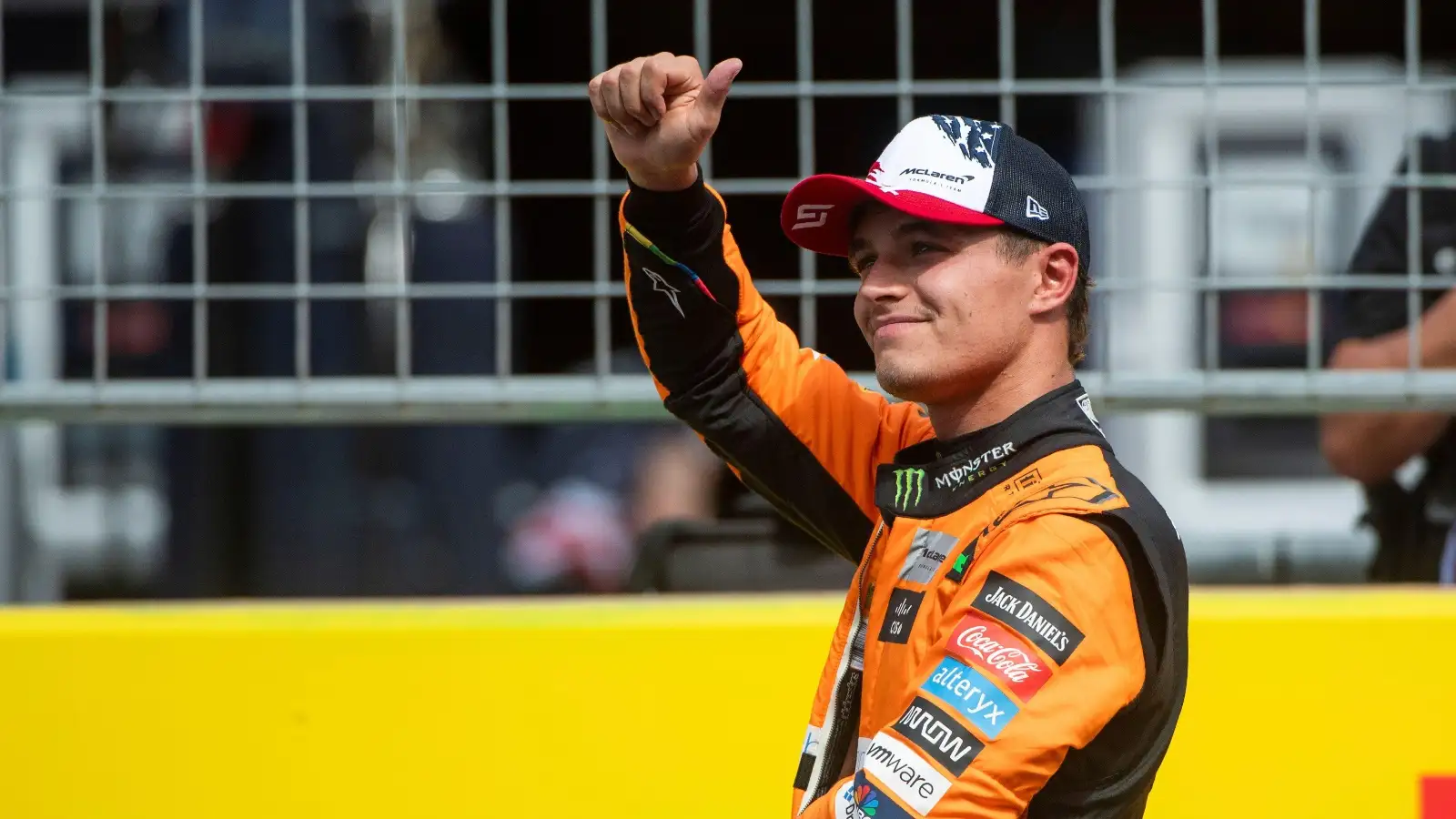
If the alternative tyre choice works, it can create a major advantage. However, if the tyre fails to perform as expected, the driver can quickly find himself in a difficult position.
In Leclerc’s case, the strategy ultimately delivered a positive result. The softer C4 tyre provided enough performance to keep him competitive, while Norris’s medium tyres eventually began to fade.
The result also provided Ferrari with valuable information ahead of the main Dutch Grand Prix. Although Sprint races are shorter than a full Grand Prix, they offer teams an opportunity to evaluate tyre behaviour, race pace and energy management under competitive conditions.
Leclerc’s second-place finish was therefore encouraging for Ferrari, particularly because the team had shown competitive long-run pace despite not appearing to have the strongest qualifying performance.
For Norris, third place represented a less satisfying outcome. The McLaren driver had started the Sprint with hopes of challenging Russell for victory, but he was never quite able to make the decisive move necessary to take the lead.
His eventual tyre decline meant that he also lost second place to Leclerc. Nevertheless, finishing third still provided useful championship points and left him in a strong position heading into the rest of the weekend.
Russell, meanwhile, enjoyed one of his strongest possible starts after the summer break. He took pole position for the Sprint and converted it into victory, building confidence after a difficult period earlier in the season.
The Mercedes driver’s performance also demonstrated that his car had strong pace around Zandvoort. He maintained a lead over Leclerc throughout the Sprint and was never seriously threatened for the win.
Leclerc’s ability to finish just 1.360 seconds behind Russell nevertheless suggests that Ferrari could remain competitive during the full Grand Prix.
The Sprint also highlighted the importance of tyre strategy at Zandvoort. The circuit contains fast corners that place significant demands on the tyres, while overtaking opportunities are limited.
That combination means that drivers and teams must carefully balance outright speed with tyre preservation. Leclerc’s decision to use the soft compound appeared risky at the beginning, but his ability to manage it gave him the opportunity to attack Norris late in the race.
Battery management was equally important. Formula One’s hybrid power units allow drivers to deploy electrical energy strategically, particularly when defending or attempting an overtake.
Leclerc’s observation that Norris had used too much of his available energy before the crucial straight allowed the Ferrari driver to identify the right moment to attack.
The move also demonstrated the level of detail drivers must consider during a Sprint. A successful overtake is rarely based solely on speed. Drivers must monitor tyre condition, battery deployment, fuel usage, gaps to rivals and the behaviour of cars around them.
Leclerc’s second place was therefore the result of both pace and tactical awareness.
For Ferrari, the performance will provide encouragement ahead of the main race. The team will now have additional information about how its car behaves over a longer stint and how the tyres respond to the Zandvoort circuit.
For Norris and McLaren, the Sprint offers a useful warning. Although the team had enough pace to remain near the front, tyre management and energy deployment could become crucial during the Grand Prix.
The Sprint battle between Leclerc and Norris ultimately demonstrated how small details can decide positions at the front of Formula One. Norris was able to maintain second for much of the race, but Leclerc patiently waited for the right opportunity.
When that opportunity arrived on Lap 18, he took advantage immediately.
With Russell securing a dominant Sprint victory, Leclerc claiming second and Norris finishing third, the Dutch Grand Prix weekend has already produced an intriguing battle between Mercedes, Ferrari and McLaren.
The main race will provide a much longer test, but Leclerc’s performance has given Ferrari plenty of encouragement. His ability to manage the softer tyre, recognize Norris’s battery situation and execute a late overtake could prove valuable lessons for the Grand Prix.
For Norris, meanwhile, the challenge will be to recover from the Sprint setback and ensure that his McLaren can maintain its performance over a full race distance.
The battle at Zandvoort is clearly far from over.