**Signs from Scott Peterson’s Fishing Boat Caused a Completely Different View of Him… Fans Shocked?**
In the first chaotic days after Laci Peterson vanished on Christmas Eve 2002, public sympathy initially surrounded her husband Scott. The clean-cut Modesto fertilizer salesman appeared on local news as a worried spouse pleading for his pregnant wife’s safe return. That image did not last. Almost overnight, attention locked onto a single object that would come to define the case in the public mind: Scott’s 14-foot aluminum fishing boat. What began as a seemingly ordinary detail quickly transformed into the centerpiece of suspicion, permanently altering how the world saw him.
Scott told police he had left home that morning to go fishing at the Berkeley Marina, more than 90 miles from Modesto. He said he wanted to test the new boat he had recently purchased. On its face, the story was simple. Yet investigators and, soon after, the media began examining every aspect of that boat and the trip with intensifying skepticism. Small details that might have seemed insignificant in another context were magnified until they formed a damning narrative.
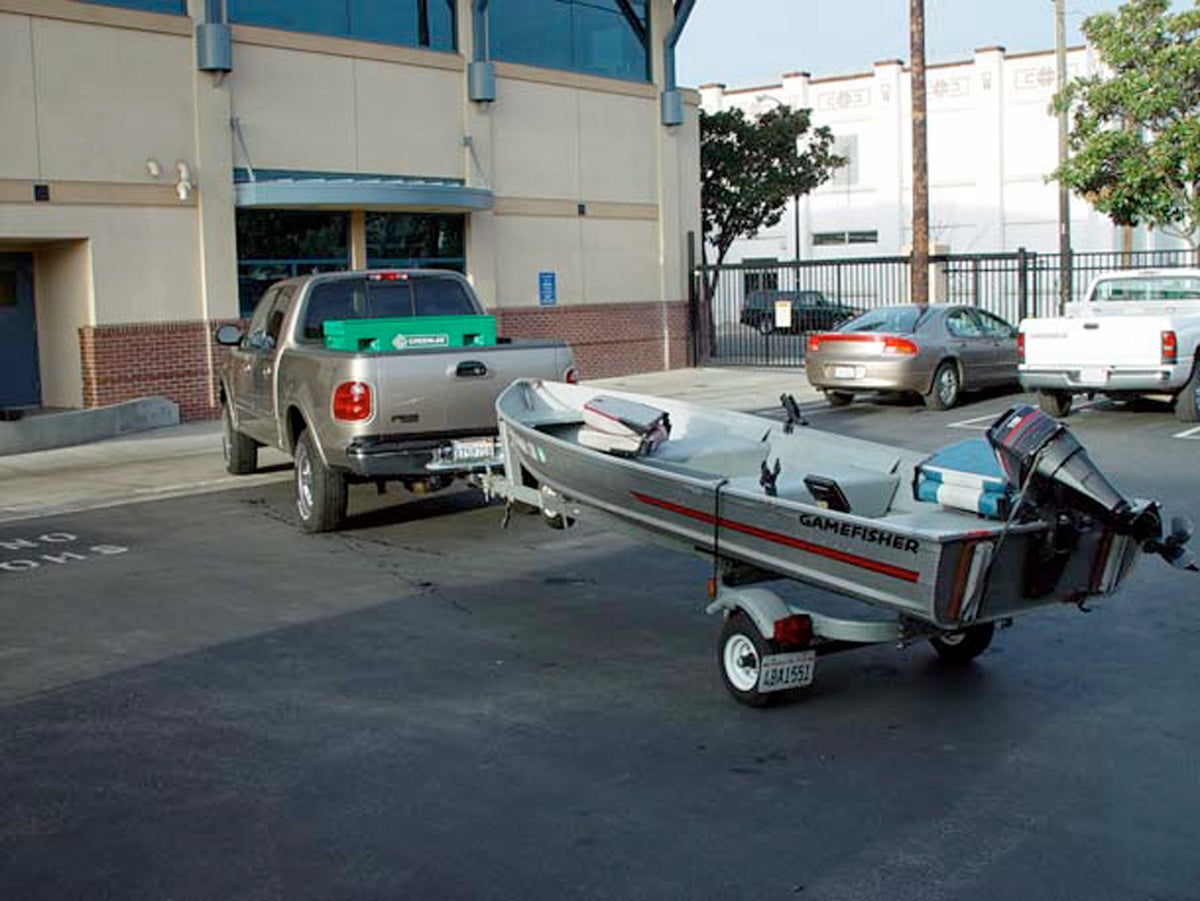
First came the timing and the secrecy. Scott had bought the boat only weeks earlier and had not told many people about it, including close family. He launched it alone on a cold, windy Christmas Eve—an unusual choice for a casual outing. When searchers later focused on the San Francisco Bay, the boat’s very existence supplied a ready explanation for how a body could have been transported and disposed of in deep water. The fact that Laci’s remains and those of her unborn son Conner eventually washed ashore separately in the Bay only tightened the connection in the public imagination.
Then there were the physical traces. Investigators found a hair consistent with Laci’s on a pair of pliers inside the boat. To prosecutors, it was a critical link. To Scott’s defenders, it was easily explained by the couple’s shared life and the transfer of hair in a home and vehicle. Yet in the court of public opinion, the hair became powerful visual evidence. Crime-scene photos of the small boat, the pliers, and the homemade anchor system Scott had fashioned circulated widely. Each image chipped away at the earlier portrait of a grieving husband.
The boat also supplied the prosecution with a timeline and a theory of opportunity. Scott’s cell phone records, toll bridge movements, and the distance between Modesto and the Berkeley Marina were mapped obsessively. The boat made the state’s story feel concrete: he could have killed Laci at home, loaded her body into the boat, driven to the marina, and slipped her into the Bay before returning to play the role of frantic husband. Without the boat, that narrative would have been far harder to sell. With it, the case gained a chilling logistical backbone.
As coverage intensified, the boat became a symbol. Cable news reconstructed the alleged journey in endless graphics. Aerial shots of the tiny vessel on the water looked sinister rather than recreational. Commentators questioned why a man whose wife was eight months pregnant would choose to spend Christmas Eve morning alone on the Bay. The more the boat was discussed, the less Scott looked like a victim of circumstance and the more he resembled a man who had planned ahead.
The shift in perception was swift and largely irreversible. Early missing-person posters and candlelight vigils gave way to headlines that framed Scott as the prime suspect. The affair he had been conducting with Amber Frey—initially unknown to the public—exploded into the open at almost the same time the boat theory solidified, compounding the damage. Yet even before the mistress became common knowledge, the boat had already done heavy lifting. It turned an abstract disappearance into a story with a weapon, a method, and a crime scene that stretched across an entire body of water.
Two decades later, the Los Angeles Innocence Project and the A&E documentary *Scott Peterson: The New Evidence* have tried to loosen the boat’s grip on the case. They argue that investigators fixated on Scott and the boat so early that they neglected alternative leads, including the Medina burglary across the street and a burned van found nearby. They note that the hair evidence was circumstantial, that the homemade anchors were never definitively linked to any crime, and that the Bay theory, while dramatic, was never supported by direct forensic proof tying Scott to the disposal of the bodies.
Still, for millions who followed the trial, the boat remains the pivot point—the moment the story stopped being about a missing woman and became about a husband who looked increasingly guilty. Fans and true-crime followers who revisit the case today often express fresh shock at how completely that single piece of property rewrote Scott’s image. One day he was the face of a desperate search. The next, he was the man with the boat, the pliers, the secret trip, and the water that eventually gave up Laci and Conner’s remains.
In the end, the fishing boat did not just carry Scott Peterson across the Bay on December 24, 2002. It carried the entire weight of public judgment. Small details—its recent purchase, its solitary launch, the hair on the pliers, the proximity to where the bodies surfaced—accumulated until they created a completely different view of the man at the center of the tragedy. Whether those details proved guilt beyond a reasonable doubt continues to be debated in courtrooms and documentaries. What is no longer debatable is the power they held over the narrative. Once the boat entered the story, Scott Peterson never again looked the same.


