In the shadowy depths of a fictional Pacific Northwest aquarium, a giant Pacific octopus named Marcellus glides across Netflix screens with eerie intelligence, solving mysteries and stealing hearts in *Remarkably Bright Creatures*. But behind the mesmerizing CGI lies a production secret so unsettling that it left Hollywood veterans performing emotional scenes with… a ghost.
The creature dominating the film wasn’t conjured from pure imagination. Months before cameras rolled, director Olivia Newman’s VFX team descended on the Vancouver Aquarium. There, they captured hours of hidden footage of a real three-year-old giant Pacific octopus named **Agnetha**. Every graceful arm movement, every curious exploration, every flash of otherworldly awareness was meticulously documented from every angle. Agnetha became the living blueprint for Marcellus. Her behaviors were studied so obsessively that the CGI version could be swapped interchangeably with real footage in certain shots.
Yet on set, the magic turned uncanny. Sally Field, playing the grieving widow Tova, and Lewis Pullman as the troubled Cameron, frequently had to interact physically with the octopus during escape sequences. Instead of a living creature, they worked with a lifeless, bizarre silicone puppet and a lighter stuffed model. The art department built a replica of Agnetha’s real tank, dropping the silicone version in for accurate lighting reference. For the actors, it meant cradling and maneuvering something cold, floppy, and unnervingly realistic — a hollow stand-in that felt like holding the ghost of a sentient being.

“It required an enormous amount of imagination,” Newman admitted. Actors were often reacting to empty space or a prop that lacked any spark of life. The disconnect created a haunting atmosphere on set — one that mirrored the film’s themes of loss and unexpected connection in ways no one anticipated.
The terror deepened through Olivia Newman’s personal lens. Just days before pre-production began in Vancouver, Newman lost her family home in the devastating Eaton Fire in Altadena, California. She arrived on set with her husband and children carrying almost nothing. As production designer filled the aquarium set with small, everyday objects — a forgotten coffee mug, a faded photograph frame, a worn tool — Newman saw them as “ghosts.” These items echoed the personal artifacts she had lost in the fire and paralleled Tova’s profound grief over her missing son.
Newman revealed that the small objects scattered around Marcellus’s tank were deliberately chosen to represent fragments of memory and unresolved pain. For Tova, they were tangible remnants of a child gone too soon. For Newman, they triggered constant reminders of her own destroyed life. Walking through meticulously dressed sets became emotionally overwhelming. Every prop was a visual echo of what had burned away — much like Tova’s nightly conversations with the octopus became a lifeline in her solitude.

The heaviest moment came when the voice of Marcellus was cast. Famed actor **Alfred Molina** — best known as Doctor Octopus in *Spider-Man 2* — was chosen to bring the cephalopod to life with narration. His delivery is proud, cantankerous, almost mystical, with a dry wit that perfectly suits the escape-artist genius. When Molina’s rich, intelligent voice first filled the soundstage during temp mixes, the set’s atmosphere grew intensely heavy. Actors performing opposite the lifeless puppet suddenly heard a fully formed personality speaking from the creature’s imagined mind. The combination — a physical ghost prop, layered memories of grief, and Molina’s commanding presence — created moments of profound unease mixed with wonder.
Newman embraced this emotional weight. The entire production became intertwined with her recovery. The film, adapted from Shelby Van Pelt’s bestselling novel, explores how connection can emerge from devastation. Tova finds solace in her nocturnal talks with Marcellus; Newman found healing in telling that story.
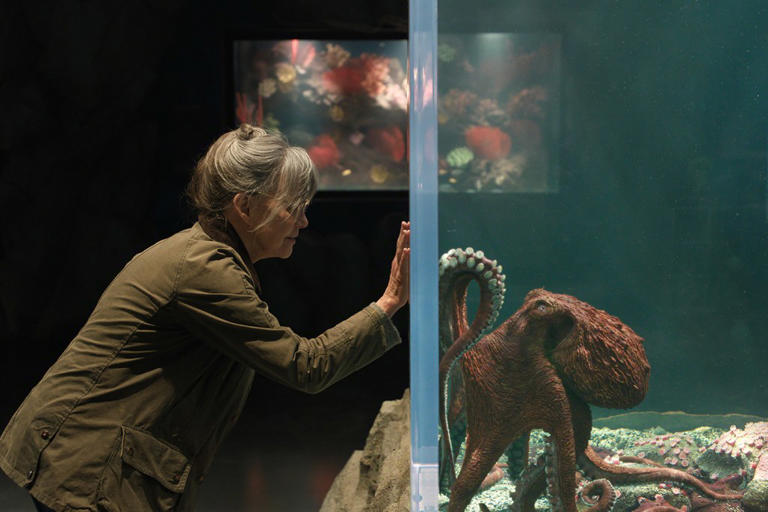
Critics and audiences have responded powerfully since the Netflix premiere on May 8, 2026. The octopus’s photorealistic movements, grounded in Agnetha’s real behaviors, blur the line between CGI and reality. Viewers are captivated not just by the visual spectacle but by the quiet humanity — or perhaps “octopus-ity” — that shines through.
Yet for those who worked on it, *Remarkably Bright Creatures* will always carry a deeper resonance. Actors performing tender scenes with a weighted puppet. A director processing fresh trauma through carefully placed “ghost” objects. A legendary voice actor infusing soul into the void.
In the end, the most terrifying secret isn’t the technology or the props. It’s how art forces us to confront our own ghosts — and how, sometimes, the most remarkably bright creatures emerge from the darkest ashes.
The film is now streaming on Netflix, inviting everyone to witness the unlikely friendship that healed both its characters and, in a small but meaningful way, its director.