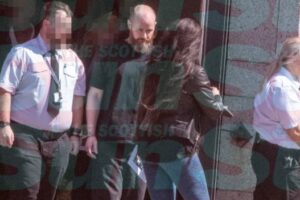
Luke Mitchell, the man convicted of murdering 14-year-old Jodi Jones in one of Scotland’s most notorious criminal cases, has appeared in public for the first time in around 15 years after being temporarily released from prison to attend his mother’s funeral.
Mitchell, now 36, was escorted under tight security to Mortonhall Crematorium in Edinburgh, where a private funeral service was held for his mother, Corinne Mitchell, who died earlier this month following a period of ill health. Prison officers accompanied Mitchell throughout the visit, and he remained handcuffed to a guard as he arrived at and departed from the service.

The outing marked the first widely photographed public appearance of Mitchell since his unsuccessful appeal proceedings more than a decade ago. Observers noted that he looked markedly different from the images most commonly associated with his case, appearing with a shaved head and a full beard.
According to witnesses, Mitchell was dressed in a black T-shirt and jeans as he followed mourners into the crematorium carrying an order of service. During the ceremony, he was seen embracing several supporters, including his long-term partner, Gemma Chapman, who has publicly maintained his innocence for years and has campaigned for his release.

The funeral was reportedly organized under strict privacy measures amid concerns that publicity surrounding Mitchell’s attendance could jeopardize permission for him to leave prison temporarily. Details of the service were kept confidential beforehand, and mourners said the identity of the deceased was not publicly displayed inside the chapel before the ceremony.
Outside the crematorium, security remained tight throughout the approximately 45-minute service. Mitchell was returned to prison immediately afterward in a vehicle accompanied by prison staff.

The temporary release has reignited public discussion surrounding one of Scotland’s most controversial murder convictions.
Mitchell was 14 years old when his girlfriend, Jodi Jones, disappeared on June 30, 2003, after leaving her home in Dalkeith, Midlothian, to meet him. Later that evening, Mitchell claimed his dog led searchers to Jodi’s body in nearby woodland.

The teenager had suffered multiple stab wounds, and investigators described the killing as particularly brutal. Her hands had been tied behind her back, and she had sustained numerous injuries to her throat and body.
After a lengthy investigation lasting around ten months, prosecutors charged Mitchell with murder. His trial began in November 2004 at the High Court in Edinburgh and became Scotland’s longest single-accused murder trial at the time, lasting 42 days.
During the proceedings, prosecutors argued that Mitchell had become obsessed with Satanism and portrayed the killing as motivated by violent fantasies. The prosecution case relied heavily on circumstantial evidence, including witness testimony and Mitchell’s behavior before and after the killing.
Mitchell consistently denied responsibility for Jodi’s death throughout the investigation and trial.
In January 2005, a jury convicted him of murder. Judge Lord Nimmo Smith described the crime as “a truly evil murder” before sentencing Mitchell to life imprisonment with a minimum term of 20 years before he could first be considered for parole.
Over the following years, Mitchell pursued multiple legal appeals challenging both his conviction and aspects of his sentence. Appeals were rejected in 2008 and again in 2011.

Supporters of Mitchell have continued to argue that the conviction represents a miscarriage of justice. They point to the absence of DNA evidence directly linking Mitchell to the killing and argue that the prosecution’s case depended primarily on circumstantial evidence rather than forensic proof.
Interest in the case increased again after the 2021 television documentary Murder in a Small Town, which examined elements of the investigation and highlighted continuing debate over the evidence presented during the trial.
The documentary prompted renewed calls from campaigners for an independent review of the conviction, although no court has overturned the guilty verdict.
Corinne Mitchell became one of the most visible figures in that campaign over the past two decades.
She repeatedly appeared in media interviews and public events maintaining her son’s innocence and calling for authorities to re-examine the evidence. Even while dealing with her own health problems, supporters described her as remaining determined to continue campaigning for Mitchell’s release.
Following the funeral, the campaign group backing Mitchell issued a statement confirming Corinne’s death and paying tribute to her commitment.
The group described her as a devoted mother who never stopped supporting her son despite personal challenges and said her determination would continue to inspire those campaigning on Mitchell’s behalf.
Supporters also expressed condolences to Mitchell, telling him that he was not alone and promising to continue pursuing what they believe is justice in the case.
Several mourners attending the funeral wore campaign badges supporting Mitchell and advocating for a review of his conviction.
Witnesses at the crematorium said Mitchell spent time embracing relatives, friends and supporters before prison officers escorted him back to the waiting vehicle.
Not everyone reacted sympathetically to his temporary release.
Some local observers said the appearance revived painful memories of Jodi Jones’ murder, which shocked Scotland more than two decades ago. Others questioned whether someone convicted of such a serious crime should be granted compassionate leave, even under strict security arrangements.
One witness said Mitchell appeared almost unrecognizable compared with photographs from his trial years, adding that they initially failed to realize who he was until noticing the accompanying prison officers and restraints.

Mitchell’s prison record has also attracted periodic attention over the years.
Reports have indicated that he was previously transferred between Scottish prisons, including HMP Greenock and HMP Shotts. In 2024, he became eligible to apply for parole after serving the minimum portion of his sentence.
However, parole authorities declined to release him. Reports at the time indicated that officials remained concerned about his level of risk and noted that Mitchell continues to deny responsibility for Jodi’s murder.
His supporters argue that maintaining innocence should not automatically prevent parole, particularly where they believe a wrongful conviction occurred.
Scottish justice authorities have not accepted those arguments, and Mitchell remains imprisoned under his life sentence.
Media reports in recent years have also suggested Mitchell became engaged to Gemma Chapman, who has publicly described him as kind and caring while insisting he was wrongly convicted.
According to previous reports, prison authorities approved the proposal, although Mitchell continues serving his sentence.
For Jodi Jones’ family, meanwhile, the conviction has long represented the conclusion of a traumatic chapter following years of legal proceedings.
Despite continuing debate among campaigners, Mitchell’s conviction remains in force, and every appeal challenging the verdict has failed.
His brief appearance outside prison for his mother’s funeral therefore represented an unusual but tightly controlled compassionate release rather than any change in his legal status.
After the service concluded, Mitchell was transported back to prison under escort, ending his first public appearance in more than a decade while the campaign surrounding one of Scotland’s most enduring murder cases continues.