Sky Sports Reporter Rachel Brookes Opens Up About ‘Horrific’ Online Abuse After Challenging Max Verstappen
Formula One Journalist Reveals the Dark Side of Covering One of the Sport’s Biggest Stars
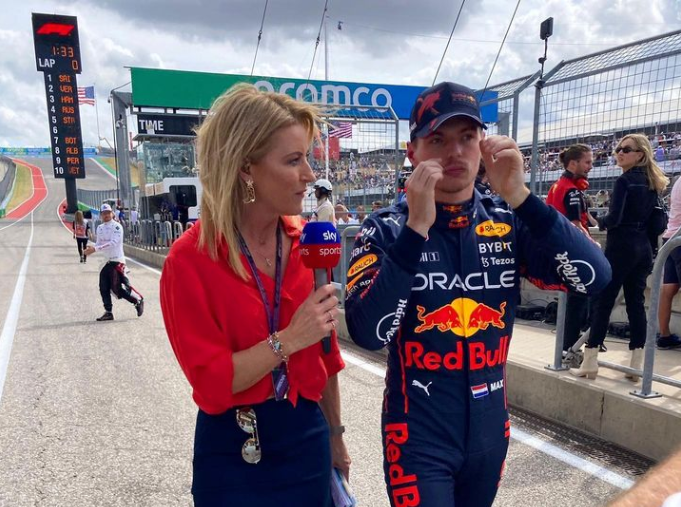
Formula One reporter Rachel Brookes has spoken candidly about the wave of online abuse she received after conducting a high-profile interview with Max Verstappen following one of the most controversial incidents of the 2025 Formula One season.
The experienced Sky Sports presenter found herself at the centre of a social media storm after questioning the four-time world champion about his collision with George Russell during the Spanish Grand Prix. What began as a routine post-race interview quickly became one of the most talked-about media moments of the season, sparking fierce debate among fans and triggering a torrent of personal attacks directed at the broadcaster.
Brookes, who has been a familiar face in Formula One coverage for years, has now revealed the scale of the backlash she endured, describing many of the messages she received as “horrific” and admitting that the experience ultimately forced her to close her social media comments.
Her comments offer a rare insight into the pressures faced by modern sports broadcasters, particularly those covering globally popular athletes whose fan bases can number in the millions.
The Interview That Sparked a Firestorm
The controversy dates back to the Spanish Grand Prix, where Verstappen became embroiled in a flashpoint moment involving Mercedes driver George Russell.
The incident generated intense discussion throughout the Formula One paddock, with commentators, analysts and former drivers debating whether the Red Bull star’s actions had crossed a line. Verstappen was ultimately handed a 10-second penalty and later acknowledged that he had made a mistake during the incident.
Following the race, Brookes was tasked with interviewing Verstappen in the media pen, where drivers routinely face questions from broadcasters and journalists.
During the exchange, she referenced comments made by former Formula One world champion Nico Rosberg, who had suggested during live commentary that the contact between Verstappen and Russell may have been deliberate.
Rather than directly answering the question, Verstappen initially attempted to deflect.

“Does it matter?” he replied.
The brief exchange immediately attracted attention among fans and media observers. While Verstappen later admitted the move had not been correct, Brookes’ decision to ask the question became a major talking point online.
For some, it was simply a journalist doing her job. For others, particularly among the Dutch driver’s most passionate supporters, it was viewed as unfair criticism of one of Formula One’s biggest stars.
Support From Inside The Industry
Despite the backlash from sections of social media, Brookes says she received significant support from colleagues throughout sports broadcasting.
According to the presenter, numerous journalists and broadcasters privately congratulated her for asking a question many others may have avoided.
She revealed that even some colleagues admitted they would have felt uncomfortable putting such a direct question to Verstappen, given his stature within the sport and the potential reaction from fans.
That support reinforced Brookes’ belief that she had acted appropriately in her role as a journalist.
The purpose of post-race interviews, particularly after controversial incidents, is to seek clarity and accountability from those involved. In Brookes’ view, the circumstances surrounding the collision made the question entirely justified.
She stressed that she was not making an accusation herself but simply relaying an opinion that had already been publicly expressed by a former world champion and respected analyst.
Within Formula One, difficult questions are often considered part of the territory, especially when incidents have major consequences for races, championships, or rivalries.

‘The Most Horrific Stuff You Could Imagine’
While professional colleagues largely supported her approach, the reaction on social media proved far more troubling.
Speaking about the aftermath, Brookes revealed that she was targeted by a stream of abusive messages that quickly moved beyond criticism of her reporting.
The presenter said some individuals questioned her suitability to work in broadcasting, while others launched deeply personal attacks.
Among the most disturbing messages were comments suggesting she should never have children because of the way she had conducted the interview.
Brookes described the messages as among the worst abuse she had ever experienced during her career.
What shocked her most was that many of the accounts appeared to belong to ordinary people rather than anonymous trolls. She recalled seeing profiles featuring family photographs and references to daughters and children, making the hostility even harder to understand.
For Brookes, the reaction highlighted how sports debates can sometimes spiral far beyond the boundaries of the competition itself.
She noted that the incident ultimately stemmed from a Formula One race, yet the responses she received became intensely personal.
Faced with the growing volume of abuse, she eventually decided to disable comments on her social media accounts.
Why She Believes The Question Was Necessary
Despite the backlash, Brookes has made clear that she has no regrets about asking Verstappen the question.
In explaining her reasoning, she pointed to the context surrounding the Spanish Grand Prix incident.
Only weeks earlier, Verstappen had produced one of the season’s most spectacular overtaking manoeuvres at Imola, earning widespread praise from commentators and analysts alike.
Brookes said that performance served as a reminder of just how talented the Dutch driver can be when operating at his best.
That is precisely why the collision with Russell frustrated her.
Like many observers within Formula One, she believes Verstappen possesses extraordinary abilities that place him among the greatest drivers of his generation.
However, she suggested that moments of controversy can sometimes overshadow those achievements and provide ammunition for critics.
Brookes explained that her frustration came not from hostility toward Verstappen but from admiration for his talent.
In her view, incidents such as the one in Spain risk detracting from the brilliance that has made him a multiple world champion.
The question, she argued, was therefore not an attempt to provoke controversy but a legitimate inquiry about a significant moment in the race.

Verstappen’s Difficult Season Continues
The debate arrives during what has been a challenging period for Verstappen both on and off the track.
After dominating Formula One for several seasons, the Dutchman has faced a more difficult campaign in 2026.
He currently sits seventh in the drivers’ standings and has managed only one podium finish so far this year, a stark contrast to the success that defined his championship-winning seasons.
The struggles have coincided with ongoing discussions about the future direction of Formula One and Verstappen’s own long-term commitment to the sport.
In recent months, he has voiced concerns about various regulatory changes and has repeatedly suggested that he may not remain in Formula One indefinitely.
Some of his comments have drawn headlines, including comparisons between modern racing regulations and video games, reflecting growing frustration with aspects of the sport’s evolution.
Against that backdrop, every controversial incident involving Verstappen tends to attract heightened attention.
The Growing Challenge of Social Media in Sport
Brookes’ experience also reflects a broader issue affecting athletes, journalists and broadcasters across modern sport.
Social media platforms have created unprecedented access between public figures and fans, allowing conversations that were impossible just a generation ago.
However, that accessibility has also opened the door to increasing levels of abuse.
Many sports personalities have spoken publicly about the emotional toll of online harassment, prompting leagues, governing bodies and broadcasters to call for stronger protections and greater accountability.
For journalists in particular, the challenge can be unique. Their role requires asking difficult questions, especially when covering controversial moments, yet doing so increasingly exposes them to intense online scrutiny.
Brookes’ account serves as a reminder of the difficult balance many reporters must strike between professional responsibility and personal wellbeing.
Standing By The Question
More than a year after the interview, Brookes remains convinced she made the correct decision.
While acknowledging the unpleasant aftermath, she continues to believe that questioning one of Formula One’s biggest stars about a controversial incident was part of her job.
The support she received from fellow broadcasters appears to have reinforced that view, even as social media reactions became increasingly hostile.
For Brookes, the episode was less about Max Verstappen himself and more about the principles of sports journalism.
In a sport built on fierce rivalries, split-second decisions and passionate fanbases, difficult questions are often unavoidable. The challenge, as her experience demonstrates, is ensuring those questions can still be asked without triggering the kind of personal abuse that has become an increasingly common feature of the digital age.




