*WAS MICK PHILPOTT REALLY A CRUEL FATHER WHEN HAPPY FAMILY PHOTOS WERE REVEALED?**
Family photos of Mick Philpott have been brought to light again, showing seemingly happy and peaceful moments. However, when compared to what was later determined in court, many are shocked by the contrast between the outward appearance and the outcome of the case.
Did the photos merely capture a moment in the past, or did they lead the public to wonder if any clues were overlooked? This contrast continues to fuel debates about how people perceive a family based on appearances and why this case continues to haunt public opinion more than a decade later.
Images that once circulated of Mick Philpott surrounded by children have resurfaced in recent discussions of the case. In some, he sits among a large group of youngsters in the living room of the Derby house. In others he appears with Mairead and, earlier, with both Mairead and his then-mistress Lisa Willis and a cluster of the children they shared or raised together. The pictures look ordinary: children playing, smiling, or simply present. They suggest a chaotic but functioning household of the kind the public had already seen when Philpott appeared on television years earlier, openly discussing his benefits-funded life with multiple partners and a growing number of offspring.
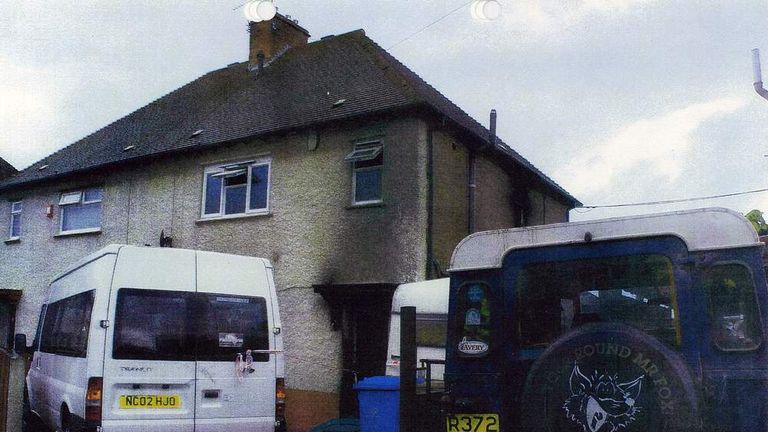
Those images sit uneasily beside the findings of Nottingham Crown Court in 2013. Mick Philpott was convicted, along with Mairead and Paul Mosley, of the manslaughter of six of the children who had appeared in some of those same photographs: Duwayne, Jade, John, Jack, Jesse and Jayden. The fire that killed them was not an accident. It was the result of a deliberate plan, orchestrated by Mick, to set the house alight, frame Lisa Willis, and emerge as a rescuer. The court accepted that the children’s safety had been subordinated to that scheme.
In mitigation, Philpott’s barrister told the judge that despite his client’s many faults he had been “a very good father” who loved the children. Witnesses, including Lisa Willis, were said to agree that there was no evidence he had ever deliberately harmed them in the ordinary course of family life. The children had been fed, clothed and, according to some accounts, enjoyed the rough-and-tumble of a large household. Philpott’s eldest son later recalled Christmas gatherings that felt fun and said the children had always been cared for in basic ways. Even the judge acknowledged that Philpott had lost six children.
Yet Mrs Justice Thirlwall rejected the label of “good father.” She stated plainly that she could not give that description to a man who had acted as he did. The children’s needs, desires and aspirations, she said, ranked very low on his list of priorities, if they featured at all. Their principal purpose, in her assessment, was to reflect on him. He craved attention and arranged family life so that everything served the pleasure of Michael Philpott. She noted a long history of violence in every one of his relationships with women, a pattern that troubled her. The fire itself was the ultimate expression of that hierarchy: a dangerous plan in which the children were instruments rather than ends in themselves.

The photographs therefore capture only a surface. A smiling child in a living-room snapshot does not record the controlling atmosphere described in court, the violence directed at the women who mothered those children, or the moment when the same father decided that risking their lives in a staged arson attack was an acceptable means to an end. Appearances of domestic normality can coexist with profound failures of care. The public, confronted years later with both the images and the verdict, is left to reconcile two versions of the same man: the father who sat among his children for the camera, and the man who poured petrol in the hallway while those children slept upstairs.
This tension helps explain why the case retains its hold on public attention more than a decade on. People look at family photographs and instinctively read love, stability or at least ordinary affection into them. When the legal record demonstrates that the same household was capable of a plan that ended six young lives, the gap feels almost unbridgeable. It raises uncomfortable questions about what was visible and what was missed. Neighbours, teachers, social services and the wider community saw a large, unconventional family. Some saw a man who loved the limelight and the idea of fatherhood. Few, it seems, saw the full extent of the risk he was prepared to create.

The photographs do not prove cruelty in every domestic moment. Nor do they prove that the children never experienced care or affection. They simply record selected instants. The court record, by contrast, records choices: the decision to start the fire, the decision to maintain a false public narrative afterwards, and a lifetime pattern in which other people existed primarily to serve Philpott’s needs and image. The judge’s conclusion was that a man who made those choices could not be described as a good father, whatever the snapshots suggested.
As the case returns to discussion through later developments—the death of Mosley, Mairead’s release, Mick’s approaching parole eligibility—the old images surface again. They invite the same comparison. A family that looked, in certain frames, almost ordinary produced one of the most disturbing criminal outcomes of its decade. The contrast between those frames and the courtroom findings continues to disturb because it challenges the assumption that outward signs of family life are reliable indicators of safety or moral character. In this instance, the appearances were incomplete. The consequences were absolute.