**WHAT MADE INVESTIGATORS CONTINUE TO REVIEW THE FINAL MINUTES BEFORE THE ACCIDENT INVOLVING RICHARD STEVENSON?**
Just minutes before the tragedy occurred, a series of events reportedly captured the special attention of investigators.
Investigative documents and security camera footage are being widely discussed as they are believed to have recorded crucial events leading up to the river collision. This is also one of the areas that authorities are continuing to examine in the investigation.
According to published records, investigators focused not only on the moment of collision but also analyzed what happened beforehand, from the boat’s trajectory and speed to witness testimonies. These details are believed to help explain more fully the cause of the tragic consequences.
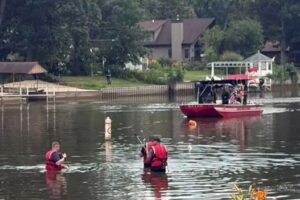
On a Saturday afternoon on the Fox River in Illinois, a triple-engine pontoon boat operated by 45-year-old Richard Stevenson collided with another vessel along the west bank. The impact killed a 48-year-old woman sitting in the passenger seat of the second boat instantly. Her husband, who was driving, sustained serious injuries. Two passengers aboard Stevenson’s boat were not seriously hurt. Stevenson remained at the scene and was taken to a hospital, where toxicology testing showed a blood-alcohol concentration of 0.236—nearly three times the legal limit of 0.08.
Prosecutors charged him with reckless homicide and aggravated driving under the influence. At a detention hearing, officials described Stevenson as a “ticking time-bomb,” citing a documented history of three prior DUI charges, three reckless-driving offenses, multiple speeding citations, and a previous boat-related violation in Florida. Witnesses reported that he had been drinking throughout the day and was observed stumbling on the dock before launching.

What has drawn sustained investigative attention are the minutes that preceded the crash. Security footage obtained from a home along the river captured Stevenson’s pontoon traveling back and forth at a high rate of speed. Approximately one minute later, witnesses heard the collision. According to the criminal complaint, the boat was operating at full throttle inside a posted no-wake zone. Investigators have treated the pre-impact video as critical because it documents both trajectory and velocity in the immediate lead-up to the strike.
The footage shows repeated high-speed passes rather than a single errant maneuver. That pattern has prompted closer examination of whether the operator was simply traveling too fast or was engaged in sustained reckless operation in a restricted area. Speed estimates placed the pontoon at approximately 80 miles per hour at the time it lost control and struck the other boat. In a no-wake zone, where vessels are required to travel slowly enough to produce minimal wake, such velocity represents a stark departure from expected conditions.
Investigators have also correlated the video with witness statements. Multiple people reported seeing the pontoon moving at high speed in the period before the crash. Passengers on Stevenson’s own boat described him as impaired and unsteady on the dock. These accounts, combined with the recorded path of the vessel, allow authorities to reconstruct not only the final seconds but the sequence of decisions that placed the boat on a collision course.
The decision to continue reviewing the pre-crash interval reflects standard investigative practice in high-speed fatal collisions. Establishing speed, direction, throttle position, and operator behavior in the minutes before impact helps determine whether the crash resulted from a momentary loss of control or from prolonged reckless conduct. In this case, the combination of full-throttle operation, repeated high-speed traverses visible on camera, and a blood-alcohol level of 0.236 has led prosecutors to argue that the collision was the predictable outcome of impaired and excessive operation rather than an unforeseeable accident.

Stevenson’s history has further shaped the focus on those final minutes. Prior DUI convictions, reckless-driving charges, and a previous citation for careless operation of a boat in Florida supplied context for evaluating the risk he presented on the water. Deputy Chief Brian Miller described him at the detention hearing as a “ticking time-bomb” whose prior record made the weekend’s events less anomalous than inevitable. A judge ordered Stevenson held pending trial. His next court date is scheduled for August 5, 2026.
The footage and related records do not alter the core physical facts of the collision. They do, however, supply a clearer view of the operator’s conduct in the critical window before impact. High-speed travel in a no-wake zone, captured on camera and corroborated by witnesses, has become central to the state’s theory of reckless homicide. The investigation continues to treat the pre-crash sequence as essential to explaining how a summer afternoon on the river ended in a fatal strike.
McHenry County State’s Attorney Randi L. Freese issued a statement underscoring the broader stakes: rivers and lakes should remain places where families can gather safely, not settings in which impaired and reckless operation turns ordinary recreation into irreversible loss. The office has pledged to pursue justice for the victim, her family, and the community.
As the case proceeds, the security video and the documented behavior that preceded the crash remain among the materials authorities continue to examine. The images capture more than the moment of impact; they record the trajectory, speed, and pattern of operation that investigators consider essential to understanding how the collision occurred. Those details, rather than any single post-crash statement, are expected to form a substantial part of the narrative presented in court.