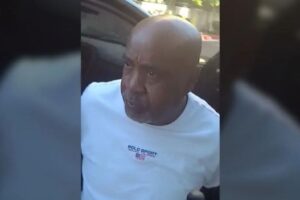
NEARLY 30 YEARS AFTER TUPAC SHAKUR’S DEATH: DUANE DAVIS UNEXPECTEDLY CHANGES HIS TUNE
For nearly three decades, Duane “Keffe D” Davis was one of the rare figures connected to the Tupac Shakur murder mystery who was willing to talk.
He talked in interviews.
He talked to investigators.
He published a memoir.
And in telling his version of what happened on that September night in Las Vegas, Davis repeatedly placed himself extraordinarily close to one of the most notorious unsolved killings in music history.
But now the situation has changed dramatically.
Davis is no longer simply a man telling stories about Tupac’s death.
He is the man on trial for it.
And suddenly, the words coming from Davis sound very different.
He denies responsibility. He disputes the prosecution’s interpretation of statements he made years earlier. His defense has challenged the reliability and admissibility of evidence connected to those accounts.
And Davis has gone even further, claiming the authorities should be looking somewhere else.
The result is an extraordinary contradiction hanging over the case:
Was Keffe D telling the truth when he publicly discussed his involvement in events surrounding Tupac’s killing—or is he telling the truth now?
THE MAN WHO WOULDN’T STOP TALKING
For years, Davis’s willingness to discuss September 7, 1996, made him a central character in the Tupac mystery.
Tupac had attended a Mike Tyson fight at the MGM Grand that evening.
After the fight, surveillance cameras captured Tupac and members of his entourage attacking Orlando Anderson, Davis’s nephew and an alleged member of the South Side Compton Crips.
Hours later, Tupac was riding in a BMW driven by Death Row Records co-founder Marion “Suge” Knight.
A white Cadillac pulled alongside them near Flamingo Road and Koval Lane.
Gunfire erupted.
Tupac was struck multiple times.
Six days later, the 25-year-old rapper died.
For years, nobody was charged.
Then Davis began speaking publicly in remarkable detail about the events surrounding the shooting.
Those words would eventually become impossible for investigators to ignore.
HIS OWN WORDS ARE NOW PART OF THE CASE
Prosecutors allege that Davis was inside the Cadillac from which the shots were fired.
Their theory does not require them to prove that Davis personally pulled the trigger.
Instead, they accuse him of playing a central role in organizing the retaliatory attack and providing the firearm.
Davis has pleaded not guilty.
And that creates the central problem for his defense.
Prosecutors have years of his statements to examine.
There are interviews.
There is his 2019 memoir, Compton Street Legend.
There are statements he made during earlier dealings with law enforcement.
There are descriptions of who was allegedly inside the Cadillac.
Taken together, prosecutors argue, Davis’s own words help connect him to the murder.
But Davis’s current position is strikingly different.
NOW HE SAYS THEY HAVE THE WRONG MAN
From behind bars, Davis has denied murdering Tupac.
He has portrayed the case against him as misguided and has suggested that other people—not him—hold responsibility for what happened.
He has also reportedly pointed toward Reggie Wright Jr., the former security chief associated with Death Row Records, while discussing an alternative theory surrounding the killing.
Wright has denied allegations linking him to Tupac’s murder.
And Davis’s accusation is exactly that: an allegation.
It is not proof.
But strategically, the shift is significant.
Instead of merely attempting to explain his old statements, Davis is offering jurors another possible direction.
That leaves prosecutors with an obvious response:
Why is this version emerging now?
WERE THE OLD STORIES EXAGGERATED?
The defense has avenues for answering that question.
One possibility is that Davis exaggerated his role when speaking publicly.
People sometimes make themselves appear closer to notorious events than they actually were.
Attention can sell interviews.
Notoriety can sell books.
A dramatic story can become more valuable than a cautious one.
If Davis’s attorneys can convince jurors that his previous public statements were embellished, then prosecutors may face a difficult problem: distinguishing genuine admissions from storytelling.
But that argument creates another uncomfortable question for Davis.
If the old version was exaggerated, which parts were false?
And why should the jury automatically trust the new version?
That credibility battle could become one of the most fascinating parts of the entire trial.
THE 2008 INTERVIEW COULD BE CRUCIAL
Another major dispute surrounds Davis’s cooperation with authorities years before he was charged.
In 2008, Davis participated in a proffer interview with investigators.
Such agreements can provide protections concerning how information supplied during cooperation may later be used.
Davis’s defense has argued that those protections should prevent prosecutors from using certain statements against him.
Prosecutors have taken a narrower view of the protections.
And a judge has ruled that important evidence connected to the 2008 interview can be presented.
That matters because the prosecution’s case is unusual.
There was no arrest immediately after Tupac’s death.
Physical evidence is decades old.
Some potential witnesses have died.
Memories have faded.
So Davis’s own words may carry extraordinary weight.
THE BOOK MAY RETURN TO HAUNT HIM
Then there is Compton Street Legend.
Davis’s memoir helped make his account accessible to millions of people.
But now that he faces murder charges, the meaning of what appeared in that book is being scrutinized far differently.
His defense has challenged how much responsibility Davis should bear for wording produced through the publishing process and ghostwriting.
Yet reports about a jailhouse telephone call have potentially complicated that argument by suggesting Davis acknowledged writing the book.
Jurors may eventually have to decide how much weight to give those statements.
Was the book an accurate account?
Was it embellished?
Was it designed to capitalize on notoriety?
Or did Davis reveal details that only someone directly involved could know?
EVEN SUGE KNIGHT HANGS OVER THE CASE
Then there is Suge Knight.
Knight was sitting beside Tupac when the bullets struck.
He survived.
Decades later, he remains one of the most important living figures connected directly to the shooting.
Prosecutors have listed him as a potential witness, although Knight has publicly indicated reluctance to testify.
His possible involvement in the trial adds yet another unpredictable element.
A case that already contains decades-old interviews, disputed statements, dead witnesses and changing accounts could suddenly include testimony from the man who was sitting next to Tupac when the shooting happened.
NOW WORDS HAVE CONSEQUENCES
For decades, Keffe D could talk about Tupac’s murder without sitting at the defense table in a murder trial.
That era is over.
Now every interview can be examined.
Every contradiction can be highlighted.
Every sentence in his memoir can be challenged.

Every newer denial can be compared with something he said years earlier.
The prosecution will attempt to transform Davis’s history of talking into evidence of participation.
The defense will attempt to show that talking about a murder is not the same thing as being legally responsible for it.
And Davis remains presumed innocent unless the state proves its case beyond a reasonable doubt.
But the dramatic shift in his public position has ensured that one question will follow him throughout the proceedings.
Nearly 30 years after Tupac Shakur was shot on a Las Vegas street, Duane Davis is finally being forced to confront his own words in a courtroom.
For decades, Keffe D helped tell the story.
Now he is fighting the version prosecutors say those words reveal.
And the question facing the jury may become devastatingly simple:
Did Duane Davis merely spend years exaggerating his connection to one of music’s greatest murder mysteries—or did he talk so much that he ultimately help build the case against himself?