WHY DID LINDSAY CLANCY’S FINGERPRINTS “DISAPPEAR”? ONE DETAIL OF EVIDENCE CAUSES SOCIAL MEDIA CHAOS
One seemingly simple piece of forensic testimony in the Lindsay Clancy murder trial has triggered an enormous question online: If prosecutors say Clancy handled the objects at the center of the case, why weren’t usable fingerprints belonging to her recovered from them?
The objects could hardly be more important.
Massachusetts prosecutors allege that exercise bands were used to strangle Clancy’s three children — five-year-old Cora, three-year-old Dawson and eight-month-old Callan — inside their Duxbury home on January 24, 2023. Investigators also recovered a knife associated with Clancy’s injuries before she jumped from a second-story window.
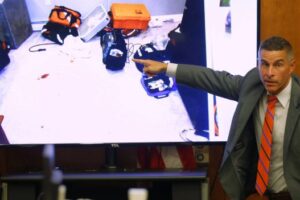
Yet when Massachusetts State Police Trooper Jonathan O’Loughlin testified about the forensic examination, jurors heard something that quickly attracted attention outside the courtroom.
There were no usable fingerprints recovered from either the exercise bands or the knife.
For some following the case online, that sounded astonishing. How could objects allegedly handled during such significant events fail to produce identifiable fingerprints?

The answer, according to the forensic testimony, is considerably less mysterious than the phrase “missing fingerprints” makes it sound.
THE KNIFE DID HAVE FINGERPRINT IMPRESSIONS — BUT THERE WAS A PROBLEM
The most important distinction is between finding evidence of fingerprint contact and recovering a print sufficiently detailed to identify someone.
O’Loughlin reportedly explained that the knife contained areas of what forensic investigators call “friction ridge impressions.”
In ordinary language, there were signs consistent with fingerprint impressions.
But they weren’t good enough.
According to his testimony, the impressions did not contain sufficient detail to make a reliable comparison with a known fingerprint.
That changes the meaning of the evidence dramatically.
It does not necessarily mean nobody touched the knife. It means investigators couldn’t obtain a fingerprint of sufficient quality to identify who had touched it.
O’Loughlin also explained that fingerprints are “very, very fragile” and that investigators sometimes examine objects without recovering anything useful for comparison.
The same fundamental problem applied to the exercise bands.
Investigators found no viable fingerprints on them that could be compared and attributed to Clancy.
And that is where social media began asking questions.
WHY WOULDN’T FINGERPRINTS BE THERE?
Television crime dramas have helped create the impression that touching an object automatically leaves behind a perfect fingerprint.
Real forensic science doesn’t work that way.

Whether a usable latent print remains can depend on numerous variables, including the material of the object, its texture, how it was handled, pressure, movement, environmental conditions and what happened to the object afterward.
A smooth, nonporous surface may offer very different opportunities for recovering fingerprints than a flexible or textured material.
Exercise bands are particularly interesting because they can stretch, twist and move during handling.
A person gripping such material isn’t necessarily pressing a motionless fingertip onto a perfectly smooth surface. Movement can smear or distort whatever ridge detail might otherwise have been deposited.
That helps explain why “no usable fingerprints” should not automatically be translated into “Clancy never touched these objects.”
It also does not prove the opposite.
Fingerprint evidence must be evaluated for what it actually demonstrates.
In this instance, investigators simply could not make a usable fingerprint identification from those objects.
SOCIAL MEDIA SEES A MYSTERY
That forensic distinction has nevertheless become a source of intense online debate.
Some people following the trial have questioned why Clancy’s fingerprints were absent from objects prosecutors connect directly to the deaths and her subsequent injuries.
Others have pointed out that an absence of identifiable prints is hardly extraordinary.
One explanation circulating in discussions is essentially the same principle described in the courtroom: forensic examiners require sufficient ridge characteristics before they can confidently compare an unknown impression with a known print.
A partial, smeared or poorly defined impression may therefore exist without being scientifically useful.
This is why saying Clancy’s fingerprints “disappeared” is misleading.
Nothing presented in the testimony establishes that identifiable fingerprints were once present and subsequently vanished.
The evidence instead indicates that investigators did not recover prints suitable for identification.
Those are very different propositions.
DOES THIS DAMAGE THE PROSECUTION?
The significance becomes even more complicated because Clancy’s trial is unusual.
Her defense is not built primarily around an argument that some unidentified intruder committed the killings.
Clancy’s attorneys acknowledge that she caused the deaths of her children.
The central dispute concerns criminal responsibility.
The defense argues that Clancy was experiencing severe mental illness, including postpartum psychosis, and therefore should not be held criminally responsible for what she did.
Prosecutors argue that her behavior demonstrated deliberate action and an understanding of what she was doing.
That means the trial’s central question isn’t simply whether Clancy physically interacted with the exercise bands.
It is what her mental state was when the children died.
The absence of identifiable fingerprints therefore has to be understood within the broader evidence rather than treated as an isolated revelation capable of deciding the case.
ANOTHER DEVELOPMENT CHANGES THE FORENSIC BATTLE
Clancy has also agreed to stipulate to certain forensic facts.

During the trial, she personally confirmed to the judge that she was voluntarily entering into stipulations concerning portions of the physical evidence.
The agreement means prosecutors do not have to spend as much time establishing certain uncontested forensic details through numerous witnesses.
That could significantly shorten a trial that originally had an enormous potential witness list.
But it does not mean every piece of forensic evidence suddenly becomes irrelevant.
Jurors still heard about the fingerprint examination, and the testimony helps illustrate the limits of forensic science.
Not every object produces an identifiable print.
Not every stain produces an unquestionable conclusion.
And not every absence of evidence proves that an event did not occur.
WHY THE PUBLIC IS SO CONFUSED
Perhaps the biggest reason for the controversy is the way forensic evidence is discussed outside court.
“No fingerprints” sounds dramatic.
“No sufficiently detailed friction-ridge impressions suitable for comparison” sounds far less sensational.
Yet those phrases can describe substantially different ideas.
That distinction matters enormously in a criminal trial.
The knife reportedly contained ridge impressions, but O’Loughlin testified there wasn’t enough detail for comparison. On the exercise bands, investigators likewise failed to obtain viable prints.
That is not evidence that fingerprints mysteriously vanished.
Nor, by itself, does it establish that somebody else used the objects.
Instead, it demonstrates something much less dramatic but arguably more important: forensic evidence frequently has limitations.
The Lindsay Clancy trial ultimately involves a much larger collection of evidence — forensic examinations, medical records, psychiatric testimony, digital information, witness accounts and Clancy’s actions before and after her children died.
The jury will have to consider all of it.
So why did Lindsay Clancy’s fingerprints “disappear”?
Based on the testimony presented so far, there is no evidence that they disappeared at all.
Investigators simply did not recover fingerprints from the knife or exercise bands that contained enough detail to make a reliable identification.
And the difference between those two statements may be exactly why one apparently mysterious piece of evidence has caused so much confusion.