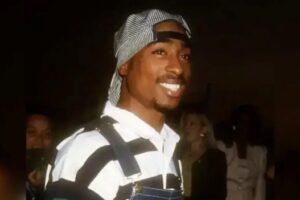
“LONG-BURIED” HOTEL RECORD COULD DESTROY KEFFE D’S ALIBI: PROSECUTORS PREPARE NEW TUPAC SHAKUR TRIAL EVIDENCE
Nearly thirty years after Tupac Shakur was gunned down on the Las Vegas Strip, prosecutors are preparing to introduce a remarkably simple piece of evidence they believe could create a major problem for Duane “Keffe D” Davis: an old hotel reservation.
Davis, the man accused of involvement in the events leading to Shakur’s September 1996 murder, has maintained his innocence and has recently insisted that he was not even in Nevada when the legendary rapper was shot.
But prosecutors reportedly believe they have evidence capable of directly challenging that claim.
According to a new RadarOnline report, investigators uncovered records showing that a room at the Monte Carlo Resort—now Park MGM—was reserved in the name of Davis’s wife, Paula Clemons, around the time of Shakur’s killing.
The discovery could become enormously significant.
On its own, a hotel reservation does not prove murder.
It does not establish who fired the gun.
It does not automatically prove Davis was inside the white Cadillac connected to the shooting.
But if prosecutors can authenticate the record and connect Davis himself to the hotel stay, it could undermine one of the simplest defenses available to him: that he was nowhere near Las Vegas when Tupac was killed.
The reservation apparently escaped scrutiny for years for an understandable reason.
Investigators reportedly searched hotel records for the names of known gang members who might have been in Las Vegas during the weekend of the Mike Tyson fight.
Clemons apparently did not fit that profile.
Her name therefore did not immediately attract the attention that Davis’s might have.
Decades later, however, prosecutors say the connection carries a dramatically different significance.
The timing is critical.
On September 7, 1996, Tupac attended the Mike Tyson-Bruce Seldon fight at the MGM Grand.
Afterward, surveillance footage captured an altercation inside the casino involving Tupac, members of his entourage and Orlando “Baby Lane” Anderson, Davis’s nephew.
That confrontation has long been considered an important part of the sequence of events preceding the shooting.
Hours later, Tupac was riding in a BMW driven by Death Row Records co-founder Marion “Suge” Knight.
While stopped near Flamingo Road and Koval Lane, a white Cadillac pulled alongside them.
Gunfire erupted.
Tupac was struck four times.
He died six days later, on September 13, 1996. He was only 25.
For decades, no one was charged with his murder.
Then Davis’s own public statements increasingly became part of the story.
Davis discussed the killing in interviews and in his memoir, “Compton Street Legend,” describing events surrounding the shooting from what prosecutors have characterized as an insider’s perspective.
In the book, Davis described the confrontation involving Anderson and subsequently discussed pursuing Tupac’s group.
Those statements have now become potentially important components of the prosecution’s case.
:max_bytes(150000):strip_icc():focal(745x252:747x254)/tupac-duane-keffe-d-davis-030625-7240712793f34cacbc019e7c00196b01.jpg)
But Davis’s defense has attempted to distance him from them.
His attorney, Carl Arnold, has argued that Davis made false or exaggerated public statements and should not simply be believed because he told sensational stories about one of the most infamous unsolved murders in music history.
Davis himself has also attempted to walk back previous accounts.
That makes the alleged hotel record particularly interesting.
A prosecutor does not necessarily have to ask a jury to trust every word Davis has ever said.
Instead, the state can attempt to compare his different statements against independent records.
If Davis says he was not in Nevada, prosecutors can produce evidence they believe places him there.
If he previously acknowledged being in Las Vegas, prosecutors can compare that statement with his current position.
And if hotel records corroborate his earlier account rather than his later denial, jurors could be asked to decide why his story changed.
RadarOnline reports that prosecutors have also pointed to a 2009 statement Davis gave to a homicide detective in which he allegedly acknowledged being in Las Vegas for the Tyson fight.
That creates a potentially uncomfortable contradiction.
The defense, however, has another major argument.
Arnold maintains that statements Davis gave while cooperating with law enforcement were made under assurances that they would not later be used against him.
He has argued that using protected statements as the foundation of a murder prosecution would violate Davis’s rights.
That dispute could become one of the most consequential legal battles surrounding the case.
But the hotel reservation is different in one crucial respect.
It is potentially independent documentary evidence.
If prosecutors can establish that Clemons booked the room and that Davis stayed there with her, they may not need to rely solely upon Davis’s contested recollections to establish his presence in Las Vegas.
Still, caution is essential.
The existence of a reservation in someone else’s name does not automatically establish that Davis personally occupied the room.
The prosecution would need to authenticate the records and explain precisely what they demonstrate.
The defense could question who checked in, who actually stayed there, how reliable decades-old records are and whether the reservation proves anything beyond the travel arrangements of Davis’s wife.
That courtroom battle could become fascinating.
Prosecutors will likely attempt to present the reservation not as isolated proof of guilt, but as one piece of a larger timeline.
The Tyson fight.
The MGM Grand confrontation.
Anderson’s beating.
The alleged movements of Davis and others afterward.
The white Cadillac.
The shooting.
Davis’s later statements.
And now, potentially, a hotel record connecting his immediate family to Las Vegas during the same critical period.
The prosecution’s challenge will be making those pieces fit together beyond a reasonable doubt.
The defense’s challenge will be separating them.
Davis has pleaded not guilty and remains presumed innocent unless the state proves its case in court. Prosecutors’ characterization of the hotel record should therefore not be confused with a judicial finding that Davis was present at the shooting or participated in Shakur’s murder.
But the potential importance of the record is undeniable.
For decades, the Tupac case has been dominated by memories, interviews, rumors and competing accounts.
A hotel reservation is different.
It is mundane.
Administrative.
Something created without anyone knowing that nearly thirty years later it might be examined in connection with one of the most famous murders in American music history.
And that may be precisely what makes it potentially powerful.
If prosecutors can prove the reservation connects Davis to Las Vegas on the weekend of Tupac’s murder, they can confront him with a devastatingly simple question:
If he truly was not there, why does the documentary trail appear to point in the opposite direction?
The answer could become one of the most closely watched moments of the entire trial.