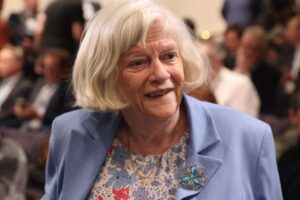
Ann Widdecombe, the outspoken former Conservative minister whose uncompromising political career was matched only by her unexpected success as a television personality, has died at the age of 78.
The former MP, who reinvented herself as one of Britain’s most recognizable entertainment figures after leaving Parliament, passed away on Friday, prompting tributes from across the political spectrum and the television world.

Her agents, Cloud 9 Management, confirmed the news in a statement.
“It is with great sadness that today we announce the death of The Right Honourable Ann Widdecombe DSG,” the statement read.
“We send our deepest condolences to Ann’s family and friends.”
For millions of viewers, Widdecombe was the unforgettable politician whose unconventional routines with professional partner Anton Du Beke turned her into one of Strictly Come Dancing’s most beloved contestants.

For others, she remained the formidable parliamentarian whose outspoken opinions on everything from Brexit and immigration to faith and social policy ensured she rarely spent long away from the headlines.
Few public figures managed to reinvent themselves as successfully as Widdecombe.
After more than two decades in Westminster, she discovered an entirely new audience in 2010 when she agreed to compete on Strictly Come Dancing.
Paired with Anton Du Beke, she entered the competition with little dancing experience and even less expectation of success.
Her technical ability rarely impressed the judges.
Week after week, she received some of the lowest scores in the show’s history, including a record-low 12 points for her Salsa, while one performance was famously compared to “a Dalek in drag.”
Yet viewers adored her.
Her theatrical routines, self-deprecating humor and determination transformed her into one of the most memorable contestants the BBC competition has ever seen.
Against all expectations, she survived until Week 10, eventually finishing sixth after becoming one of the series’ biggest talking points.
Her popularity proved so remarkable that seven MPs later signed a parliamentary motion congratulating Widdecombe and Du Beke for “putting a smile on the nation’s faces.”
She even returned to the famous ballroom in 2018 for the Christmas special, once again dancing alongside Du Beke in a festive American Smooth.
Strictly was only the beginning of her entertainment career.

She later appeared on Celebrity Big Brother in 2018, where, despite generating controversy over her outspoken views, she finished as runner-up after winning over many viewers with her resilience and unmistakable personality.
She also explored acting, making her pantomime debut in Snow White and the Seven Dwarfs before later fulfilling what she described as a lifelong ambition by playing the Evil Queen.
Television audiences had previously become familiar with her through Louis Theroux’s acclaimed documentary When Louis Met… Ann Widdecombe, which offered a rare glimpse into the private life of one of Britain’s most recognizable politicians.
Born in Bath on October 4, 1947, Widdecombe spent part of her childhood in Singapore before returning to Britain for her education.
She studied Latin at the University of Birmingham before continuing her education at Lady Margaret Hall, Oxford, where she read Philosophy, Politics and Economics.
Her political journey began in local government before she entered Parliament in 1987 as Conservative MP for Maidstone.

Over the following 23 years, she became one of the party’s most recognizable and outspoken figures.
She served under Prime Minister John Major in several ministerial positions, including Minister of State for Employment before taking responsibility for Britain’s prison system as Minister of State for Prisons.
Widdecombe became known for her uncompromising style, famously visiting every prison in the country while serving in government.
Her political career was never short of memorable moments.
Perhaps the most famous came in 1997 when, during an inquiry into prison escapes, she remarked there was “something of the night” about former Home Secretary Michael Howard.
The phrase immediately entered British political folklore and was widely viewed as damaging Howard’s subsequent Conservative leadership ambitions.
Although she unsuccessfully considered standing for the Conservative leadership herself in 2001, Widdecombe remained one of the party’s best-known voices until retiring from Parliament in 2010.
Her departure from Westminster did not signal retirement from public life.
Instead, she became increasingly active in campaigning for Brexit.
Disillusioned with Theresa May’s handling of Britain’s departure from the European Union, Widdecombe left the Conservative Party and joined Nigel Farage’s Brexit Party.
She was elected as a Member of the European Parliament in 2019, using her maiden speech in Strasbourg to compare Brexit supporters to slaves rising against their owners—remarks that generated international attention and fierce criticism.
In 2023, she joined Reform UK, continuing to campaign alongside Farage and becoming one of the party’s most recognizable supporters.
Remarkably, just days before her death, Widdecombe was still appearing on television, passionately defending Farage ahead of the Clacton by-election.
Farage paid an emotional tribute following news of her passing.
He described Widdecombe as “an absolute force of nature” whose loyalty never wavered despite occasionally challenging him privately.
“The times when I used to get a phone call from Ann saying she disagreed with what I’d done or what I’d said,” Farage recalled.
“We’d sit down over a coffee and talk things through.
“But in public, she was an incredibly loyal ally.”
He added that her decision to join the Brexit Party had been a defining moment.
“She made us look serious. She made us look real.”
Conservative leader Kemi Badenoch also honored Widdecombe’s legacy.
“My deepest condolences and those of the Conservative Party to the family and friends of Ann Widdecombe,” she wrote.
“She was a formidable politician who was never afraid to speak her mind and fought hard for what she believed.”
Throughout her career, Widdecombe’s Christian faith remained central to both her politics and personal life.
In 1993, she converted from the Church of England to Roman Catholicism after disagreeing with the Anglican Church’s decision to ordain women as priests.
Her religious convictions shaped many of her most controversial political positions.
She consistently opposed abortion and same-sex marriage while advocating tough sentencing policies and maintaining an uncompromising stance against illegal drugs.
She also questioned aspects of climate change policy, arguing Britain should not “suffer” under net zero commitments.
Those opinions often divided public opinion, but supporters admired her willingness to defend deeply held beliefs regardless of criticism.
Away from politics, Widdecombe lived a remarkably private life.
She never married and never had children, once proudly describing herself as a “spinster.”
She spoke openly about choosing career over marriage after ending a relationship during her university years.
Instead, she devoted much of her affection to animals, particularly cats, frequently writing about them on her personal website while supporting various animal welfare campaigns.
She was also an accomplished author, publishing both fiction and political books throughout her career.
Her sharp wit became legendary.
While hosting Have I Got News For You, comedian Paul Merton later joked that being instructed by Widdecombe to “be funny” represented “the lowest point” of his professional career.
The exchange perfectly captured the fearless, no-nonsense personality that defined her public image for decades.
Whether in Parliament, on reality television or campaigning on behalf of causes she believed in, Ann Widdecombe remained unmistakably herself.
She inspired admiration, criticism, laughter and debate in equal measure.
Few politicians successfully crossed into popular culture.
Even fewer managed to become a genuine entertainment icon while never abandoning the convictions that first brought them into public life.
From the House of Commons to the Strictly ballroom, from Brussels to pantomime stages, Widdecombe carved out one of the most distinctive careers in modern British public life.
Her death marks the end of an era for politics and television alike, leaving behind a legacy defined not only by controversy and conviction but also by an unforgettable personality that audiences never stopped watching.